The journey towards success in any field, whether in business, sports, academics, or personal growth, is like taking a road trip to a new place. You know your destination, but unexpected detours, roadblocks, and wrong turns will come your way. The key to successfully reaching your goals is the ability to experiment, reflect, learn, and act—a virtuous cycle that helps you improve your performance during your journey.
Many people don’t fail because they lack talent. They fail because they don’t learn from their mistakes. A Harvard Business Review study found that teams that reflect on their performance improve by 20% over time. David Kolb’s experiential learning theory says that learning is most effective when it follows a cycle of experience, reflection, conceptualization, and action. The upshot is that if individuals consistently test ideas, reflect, adjust their approach, and take corrective action, they can accelerate their progress.
Let’s go deep and understand how the cycle of Experimentation, Reflection, Learning, and Action (ERLA) work together to improve performance in any venture.
The E.R.L.A. Cycle: Experiment, Reflect, Learn, Act
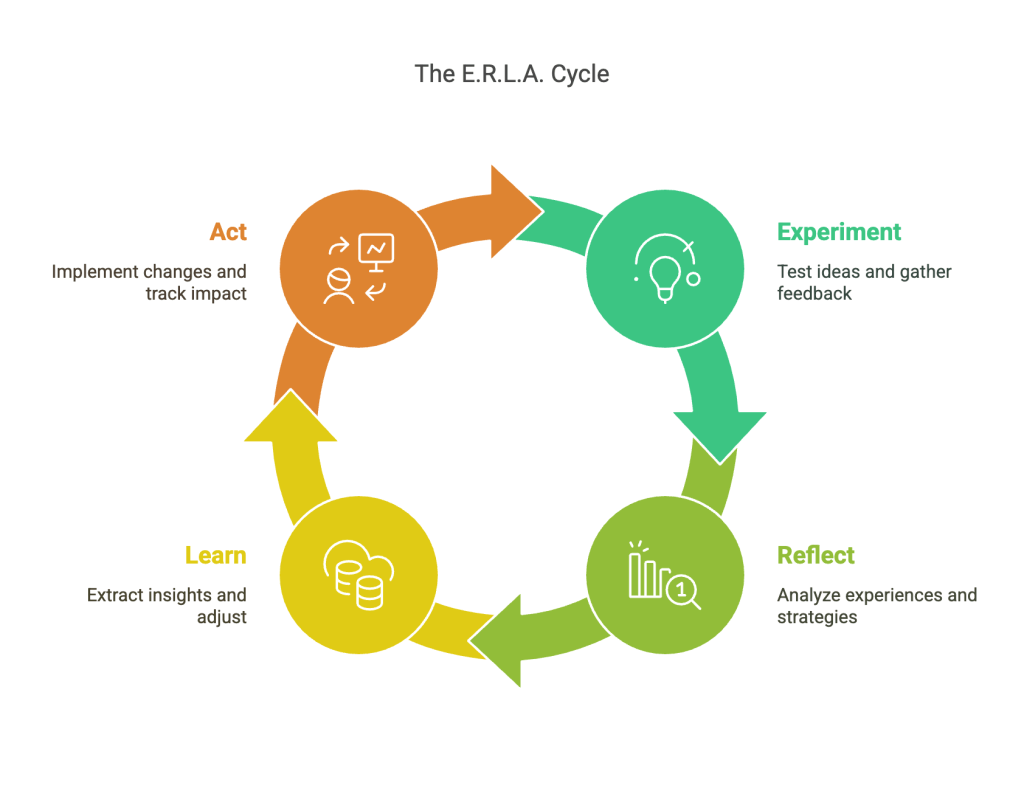
Step 1: Experiment—Test Ideas & Take Action
Action without thought is reckless, but overthinking without action leads to stagnation. The first step is trying different approaches and collecting real-world feedback.
Why Experimentation Matters:
- Reveals What Works and What Doesn’t: Instead of relying on assumptions, taking action provides actual data.
- Builds a Habit of Execution: People who act quickly learn faster.
- Creates a Base for Reflection: Without action, there’s nothing to analyze and improve upon.
Example: Zepto’s 10-Minute Delivery Experiment
When Zepto launched in 2021, India’s quick commerce space was untested. Nobody gave it a thought. People laughed at the idea. Most companies believed that delivering groceries in 10 minutes was logistically impossible. But Zepto experimented starting with a few hyperlocal dark stores, optimizing delivery routes, and testing whether customers actually valued ultra-fast delivery. Their experiment proved demand existed, leading to a funding surge and an industry-wide shift toward 10-minute delivery.
Step 2: Reflect—Make Sense of Experiences
Reflection is about stepping back and analyzing what’s working, what’s not, and why. Many people like action, get stuck in execution mode and never take the time to evaluate their approach. But without reflection, it is easy to repeat mistakes. Reflection allows you to refine your strategies.
How Reflection Helps:
- Deepens Understanding and Retention: Connecting new experiences with past knowledge creates stronger insights.
- Identifies Gaps and Areas for Improvement: Reflection helps pinpoint what’s missing in your approach and what it takes to get back on track.
- Turns Surface Learning into Deep Learning: Instead of just moving on from failures, reflection allows you to extract key learnings from your experiences and apply them effectively in your next attempts.
Example: Flipkart’s Logistics Strategy
In its initial days, Flipkart struggled with delayed deliveries and poor customer experience. Instead of blaming external factors, they took a deeper look at their operational gaps. Instead of brushing it off as a temporary issue, they reflected on their weaknesses and realized they needed more control over logistics. This led to the creation of Ekart, their in-house logistics arm, which improved delivery speeds and customer satisfaction.
Step 3: Learn—Extract Key Insights
Reflection must lead to concrete learning and adjustments. Successful people identify patterns in their failures and successes and adjust accordingly.
How to Learn Effectively:
- Develop Metacognition: Understanding how you think and learn can help refine strategies and decision-making for better performance in the future.
- Seek External Perspectives: Talking to mentors, studying experts, or analyzing industry data can provide fresh insights.
- Use data, Not Opinions for learning: Gut feelings are useful, but decisions that are backed by data are more reliable.
Example: Thomas Edison’s Continuous Experiementation
Edison famously conducted over 1,000 failed experiments before successfully inventing the light bulb. Instead of seeing failures as dead ends, he reflected on what didn’t work, learned from each attempt, and kept adjusting his approach. His method of continuous experimentation and learning helped him become one of the most prolific innovators of modern times.
Step 4: Act—Implement Learnings Quickly
Learning without action is useless. Many people analyze their failures but fail to act on what they have learned. The most successful people implement changes fast and track their impact.
Steps to Take Action:
- Set Clear, Measurable Goals: Define specific changes and track their impact.
- Adjust & Test Again: If one method fails, tweak it and try again immediately.
- Create Feedback Loops: Regularly evaluate whether new strategies are working.
Rohit Sharma’s White-Ball Cricket Transformation
After India’s disappointing exits from the 2021 and 2022 T20 World Cups, Rohit Sharma reflected on these failures. He realized that India’s conservative batting approach was not working in modern white-ball cricket. They needed to adopt an aggressive batting approach if they wanted to win the tournaments. Rohit Sharma led from the front. The result is that now India is a dominant force in white ball cricket losing only one match in the last 23 matches in ICC world tournaments and has won two world tournaments back to back. His ability to step back, assess the problem, identify the key learnings, and implement changes helped the team become successful.
Success is a Continuous Cycle
Success happens when you continuously learn what works and what doesn’t. You can create a virtuous cycle of learning by consistently experimenting, reflecting, learning, and taking action. The people who improve the fastest are those who test, analyze, adjust, and act.
By following the ERLA cycle, you can create a system for continuous growth, avoiding stagnation and accelerating progress.



 Growth Factorials
Leave a comment