This is the second article in a series of three on how AI is reshaping work and how you need to adapt to stay ahead. In the first article, we talked about adopting the right mindset.
Adopting the right mindset is crucial, but what practical steps can you take to reinvent your role in an AI-driven workplace? This second part provides a step-by-step framework for professionals in non-revenue-generating roles to evaluate their current responsibilities, identify what can be automated, and redesign their roles to focus on high-value human skills.

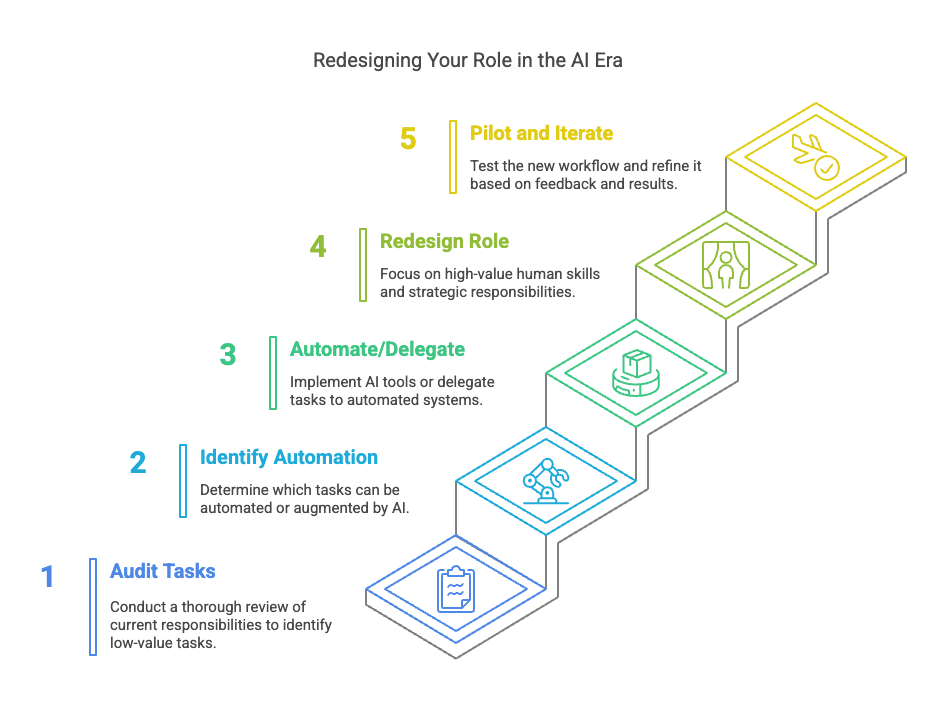
Step 1: Audit Your Current Tasks and Responsibilities
Begin with a clear-eyed inventory of your role. List the core tasks you perform over a week or month. Which deliverables are you responsible for, and what processes do you follow? This audit should capture everything from routine administrative work (e.g. updating reports, scheduling meetings) to complex, analytical tasks (e.g. analysing trends, solving exceptions). By mapping out your “task portfolio,” you create a baseline to identify which parts of your job are low-value or repetitive versus those that are strategic or creative. Be brutally honest here – many of us spend significant time on busywork that doesn’t truly require our human expertise.
Step 2: Identify Tasks Ripe for Automation or Augmentation
Review your task list through an automation lens. For each task, ask: Could a machine do this faster or more accurately? Repetitive, rules-based tasks are prime candidates for AI or automation. For example, compiling a routine report, reconciling data, logging transactions, or answering standard queries – these have likely already been tackled by AI solutions in leading companies. Even more complex tasks, like initial data analysis or scheduling, can often be offloaded to algorithms. In an operations role, perhaps inventory reorders or status updates could be handled by an AI-driven system. In analytics, data cleaning or generating basic charts might be automated with the right tools. Flag all automatable tasks, even if the tech isn’t currently in place at your company. This exercise is about envisioning the near future of your role. If you are unsure, research what tools exist; chances are, if it is repetitive or data-driven, AI can at least assist with it.
Step 3: Automate, Delegate, or Eliminate Low-Value Work
Now, take action on those automation-prone tasks. Where possible, implement AI tools or workflows to handle them, or delegate them to automated systems your organisation provides. For instance, if you regularly prepare a weekly metrics dashboard, see if it can be auto-generated by your BI software or a script. If you spend hours sorting or cleaning data in Excel, explore using a Python script or an AI data prep tool. The goal is to offload as much low-value, routine work as possible. This is not shirking responsibility. Instead, it is freeing your capacity for more important work, e.g. by leveraging AI to handle administrative tasks like benefits management and answering routine queries, HR professionals can significantly reduce their busywork and shift their focus to strategic initiatives. You can replicate this in your role. As you automate or shed tasks, document the time and effort you save. This will be useful to demonstrate increased productivity and to justify further AI resources.
Step 4: Redesign Your Role Around High-Value Human Skills
With mundane tasks minimised, refocus your role on the areas where you, a human, provide irreplaceable value. Typically, these are tasks requiring judgment, creativity, empathy, or complex problem-solving. Look at your original list and highlight the parts that AI cannot do well. For an analyst, that might be interpreting ambiguous results, crafting a story from data, or consulting with stakeholders to define the right questions. For an operations manager, it could be negotiating with a supplier, improving a process based on on-the-ground insight, or coordinating cross-functional teams. These become the core of your redesigned role. Actively allocate more time to them. You may need to upskill to deepen these capabilities, e.g. improving your data storytelling or stakeholder communication skills. The payoff is that you transform from a task executor to a strategic advisor or problem-solver in your domain. You should aim to spend your time where you make a unique impact, whether it is innovating new solutions, providing a human touch with clients, or devising strategy.
Step 5: Pilot the New Workflow and Iterate
Transitioning to a revamped role won’t happen overnight. Treat it as an ongoing pilot program for yourself. Start integrating AI into one or two of your tasks and simultaneously take on a new high-value project in the freed time. For example, an operations specialist might automate the monthly supply report and then volunteer to lead a project on improving delivery turnaround. Monitor how it goes: Do the AI tools actually save you time? Are there glitches or do you need to fine-tune the process (e.g., double-checking the AI’s output initially)? Also, gauge the impact of your new strategic project. Is your contribution being noticed? Gather feedback from your manager or stakeholders. You may find you need to adjust – maybe a certain task isn’t as automatable as thought, or maybe you can push even more work onto the AI once it proves reliable. Iteratively refine your workflow. The goal is that after a few cycles, your day-to-day job looks very different: less drudgery, more meaningful work. You should be able to articulate how your role has shifted, e.g. I used to spend 60% of my time on data pulls; now I spend that time meeting with business units to plan initiatives, thanks to an AI tool that does the pulling. Importantly, share your success. Demonstrating initiative in leveraging AI and upping your game not only boosts your career prospects but also signals to the organisation the value of transforming these support roles.
By systematically evaluating your role and leveraging AI to handle the right tasks, you elevate your value to the organisation. You move out of the shadow of being a support cost centre and closer to being a critical enabler of growth, innovation, and success. In the final part of this series, we will map out how to continue this momentum over the short, medium, and long term of your career, ensuring you not only redesign your current role but also future-proof your career in the age of AI.


 Growth Factorials
Leave a comment