This is the final article in a series of three articles on how AI is reshaping work and how you need to adapt to stay ahead. In the first article, we talked about adopting the right mindset to stay ahead. In the second article, we discussed a framework for professionals to redesign their roles to focus on high-value human skills that will not be easily replaced by AI.
The final part of our series offers a roadmap for continuous growth, covering the skills to build, how to orchestrate AI-human workflows, and ways to lead change in your organisation. By planning ahead, you can ensure you stay **indispensable in the evolving world of AI-driven work.
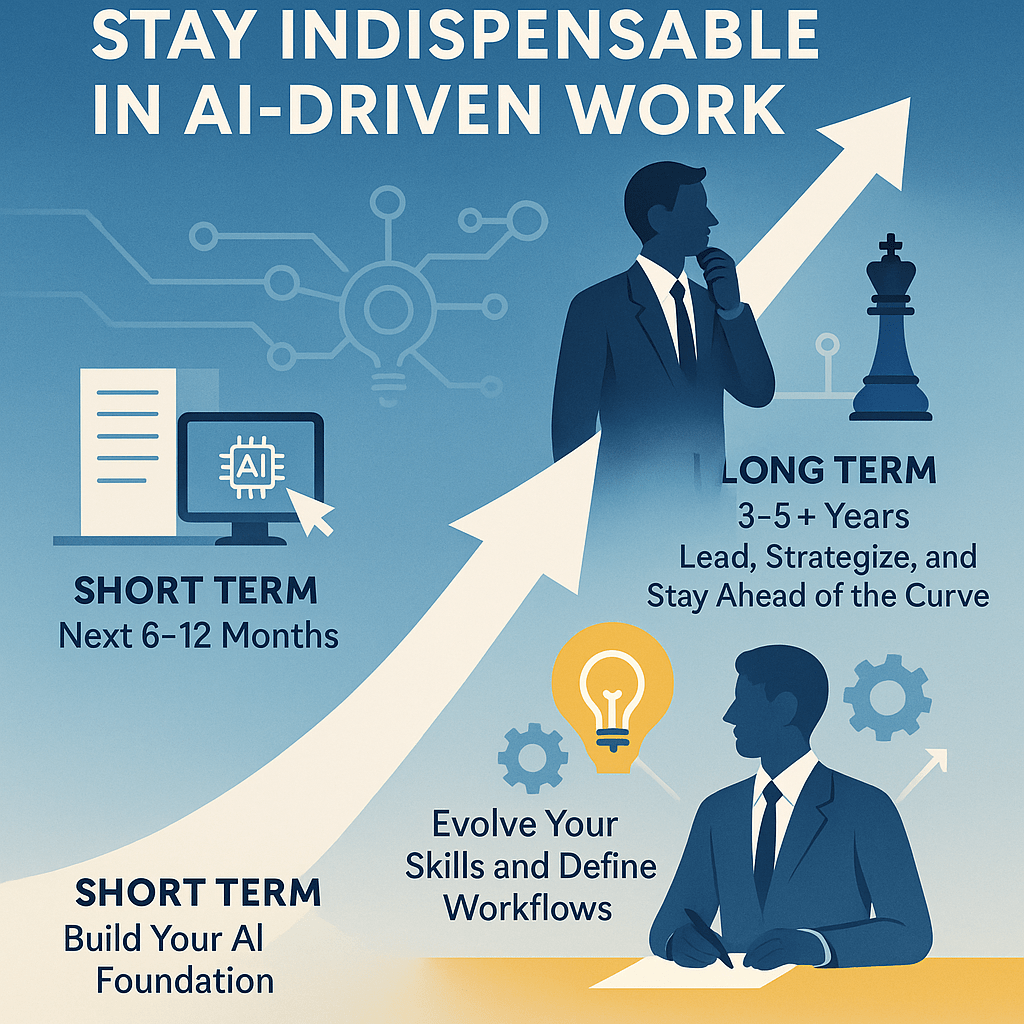
Short Term (Next 6–12 Months): Build Your AI Foundation
In the immediate term, focus on building a foundation of AI literacy and integration in your current role. This means:
- Learn and Experiment: Invest time in learning the AI tools relevant to your field. Take online courses or workshops on how you can use AI in your job to automate tasks you have already identified. Use AI tools for small tasks to get comfortable (e.g., try an AI scheduling assistant, or use a chatbot to draft routine emails). Hands-on experience will help you understand AI better and increase your confidence.
- Identify Quick Wins: Look for “low-hanging fruit” where AI can make your life easier right now. Perhaps there’s a report that could be generated with a simple script that you created with AI, or you can use ChatGPT to outline a first draft of a presentation. By implementing a few quick automations or AI assists, you immediately boost your productivity. These wins will also build your credibility as someone who can leverage new technology effectively.
- Stay Curious and Adaptive: Cultivate a mindset of continuous learning. In the short term, this means staying curious about AI developments in your industry. Subscribe to a newsletter or follow experts on LinkedIn to keep tabs on new AI applications. When a new update or tool comes out, play with it. This proactive curiosity is a mindset skill in itself – it trains you to adapt quickly, which is incredibly valuable in a time of rapid change.
Medium Term (1–3 Years): Evolve Your Skills and Define Workflows
Looking a bit further out, aim to deepen and broaden the skills that allow you to ride the AI wave, and position yourself as a leader in human-AI collaboration:
- Master High-Value Skills: As routine work fades, certain human skills become even more critical. Double down on developing skills such as critical thinking, creativity, communication, and business acumen. For instance, you might take on projects that force you to practice complex problem-solving or enrol in a course to improve your business storytelling and influence skills. These soft skills are hard for AI to replicate and will set you apart in roles that increasingly emphasise strategy and relationships.
- Domain + AI Expertise: Strive to become someone with deep domain expertise and strong AI know-how. If you are in supply chain, for example, you should be the person who not only understands logistics deeply, but also knows how to leverage AI forecasting tools to improve logistics. This dual capability lets you design how AI fits into your team’s processes, because you grasp both the technical and business sides. Being this bridge between technology and business is a hugely valuable position for career growth.
- Own and Optimise the Workflow: In your team or department, volunteer to be the point person for AI integration. This could mean leading a small task force to evaluate new AI software. By doing this, you practice workflow design: figuring out which tasks go to AI and which to humans for the best outcome. You might create a self learn module for your team on using a new AI tool. Through these efforts, you are effectively defining AI-human collaboration in your workplace. This not only improves overall team performance but also builds your leadership and project management skills.
- Mentorship and Knowledge Sharing: As you build expertise, share it. Mentor others in your department who are less familiar with AI. This cements your own knowledge and establishes you as a forward-thinking leader. In the medium term, being an agent of change can position you for formal leadership roles. Organisations value individuals who help their peers adapt, because cultural adoption of AI is a big hurdle for many companies.
Long Term (3–5+ Years): Lead, Strategise, and Stay Ahead of the Curve
In the longer horizon, your goal is to solidify yourself as a leader who drives AI-enabled transformation and to continuously adapt as AI technology evolves:
- Embrace Leadership Opportunities: With several years of experience leveraging AI in your function, you should seek roles where you can shape the direction of a function or the organisation. This could mean moving up to manage a team or function, where you can implement AI-human workflow practices at scale. For example, as a Head of Operations, you might roll out an AI-driven process across the entire department. In these positions, you set the vision for how technology and people blend to achieve the business goals. Focus on how your initiatives tie AI efforts to clear outcomes (cost savings, revenue growth, better customer satisfaction, etc.).
- Strategic Vision and Innovation: The further you go in your career, the more you need to be looking around corners. Continuously scan how AI is changing your industry. What new business models or opportunities does AI enable? Develop a viewpoint and propose ideas. You might pilot an AI-driven product internally that showcases your department’s innovative potential. By thinking strategically about AI (not just operationally), you ensure you are part of the conversation on “what’s next.” This will also help you shape the future of the organisation.
- Ethics and Governance: As AI becomes ubiquitous in your workflows, long-term leaders need to grapple with questions of ethics, fairness, and risk. Differentiate yourself by building knowledge in AI governance – understand issues like data privacy, bias in algorithms, and regulatory requirements in your field. The ability to lead AI usage responsibly will be highly valued; companies face reputational and legal risks if AI is misused. With AI making more decisions, the human ability to ensure ethical and fair outcomes becomes critical.
- Lifelong Learning and Flexibility: Finally, commit to never getting complacent. The “long term” in an AI context can bring radical shifts (think about how generative AI went from niche to mainstream in a couple of years). Be prepared to reinvent yourself again. This might mean learning entirely new AI paradigms. Stay flexible about your career path – new roles will emerge that don’t exist today. By keeping an open mind, you can navigate into positions that capitalise on your unique mix of experience, skills and mindset. The thread through your career should be growth: every stage, you have added skills, taken on bigger challenges, and remained ready to pivot as technology and business demands change. That is the ultimate insurance against obsolescence.
Reflection: Are You Prepared for the Future of Work?
To conclude this series, here are a few reflection prompts and scenarios to consider. Use these to gauge your readiness and spark ideas for your own journey in an AI-driven world:
- What if… 90% of what you do today became automated in the next 2 years? How would you redefine your role or profession? Sketch out a version of your job that focuses on the remaining 10%, and imagine how you could expand those into new value for your organisation.
- Strengths vs. Automation: Make two quick lists: (A) your top skills/talents that add value (e.g. “I simplify complex ideas for others” or “I negotiate great deals with vendors”), and (B) the main tasks you do daily. Now, cross out anything in list B that technology could do. Are your true strengths being utilised enough in your current role? If not, how can you reposition your job (or seek a new one) that centres on what you are uniquely good at?
- Lead the Change: Think of your team or department. If you were put in charge of integrating AI into its operations, what 1–2 changes would you implement first? It could be as simple as “adopt an AI customer service chatbot to handle customer inquiries”. This thought exercise prepares you to be proactive rather than waiting for directives to come from higher-ups.
- Visualise 5 Years Ahead: Envision a scenario in 2030 in your industry. What does a typical day look like for someone in your current role? Write a short narrative. For example, “I start the day reviewing my AI assistant’s overnight analysis, then I host a strategy stand-up with cross-functional leads… By afternoon, I am focusing on a complex client negotiation aided by AI simulations…” etc. This can highlight gaps in your current skill set that you might want to fill now to be that person in 2030.
- Personal Learning Plan: Finally, reflect on how you learn best and where you will find the time to upskill. The most resilient careers involve continuous learning. Do you have a plan for ongoing education? This could be as formal as aiming for a certification within 18 months, or as informal as dedicating an hour a week to reading up on tech trends. Commit to a plan that excites you.
By contemplating questions like these, you keep yourself engaged and oriented toward the future, rather than clinging to the past. The professionals who thrive in an AI-driven world will be those who anticipate change and actively prepare for it, leveraging the best of technology and the irreplaceable human qualities they possess. Embrace this journey, and you will not only stay relevant, you will define what relevance means in the years to come.



 Growth Factorials
Leave a comment